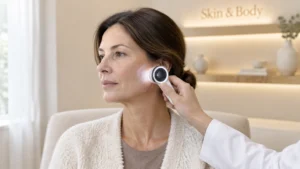


At AGE LESS Laser+ Clinic, serving Esquimalt & the greater Victoria area for over 20 years, advanced light-based Appearance Enhancement is approached as more than surface care. Full Body Photobiomodulation (PBM) is used to support skin renewal, tissue recovery, and whole-body comfort through evidence-based, non-invasive treatment.
This medical-grade Full Body Photobiomodulation Wrap is designed to rejuvenate skin from head to toe while helping calm inflammation and body aches.
Below is a focused look at how light therapy works, why wavelength matters, and what full-body photobiomodulation can do for your skin, recovery, and overall wellness.
*
What Is Photobiomodulation (Red Light Therapy)?
At its core, photobiomodulation (PBM), often called red light therapy**, uses specific wavelengths of light to stimulate cellular activity. Light photons penetrate the skin and are absorbed by chromophores within the cells. That absorption triggers a cascade of biological effects.
A key part of that process happens in the mitochondria, the cell’s energy powerhouses. When stimulated by the right wavelengths, mitochondria produce more adenosine triphosphate (ATP), the energy your cells use for repair and regeneration. Red and near-infrared light have also been associated with increased DNA and RNA activity. LED wavelengths can pass through tissue to a depth of approximately one inch, which is why photobiomodulation can influence both surface-level skin concerns and deeper tissue recovery.
LED as a clinical technology was first developed for use by NASA to support healing of damaged retinas. Today, that same foundational science is applied far more broadly in skin and body protocols.
Dual-Wavelength Precision: 650nm & 830nm Super Luminous Diodes
Not all light therapy is created equal. The efficacy of photobiomodulation depends on wavelength, tissue depth, and the quality of light delivery. At AGE LESS Laser+ Clinic, the full body wrap uses high-intensity Super Luminous Diodes (SLDs) at two clinically useful wavelengths:
1. 650nm (Red Light) : Deep Dermal Rejuvenation
Target Area: The upper to middle layers of the skin.
Skin Elasticity & Firmness: Red light stimulates fibroblasts to produce more collagen and elastin, helping plump mature skin and improve firmness. Research has shown increases in collagen density of up to 31% after several weeks of consistent treatment, but that figure is not a promise. Results depend on consistency and on the specific concern being treated.
Inflammation & Circulation: It helps reduce inflammation and improve circulation, which supports healthier-looking, more resilient skin.
2. 830nm (Near-Infrared Light) : Deep Tissue & Anti-Inflammatory Healing
Target Area: Deeper tissue layers, including muscles, tendons, and joints.
Tissue Repair & Blood Flow: Near-infrared light reaches deeper layers to support tissue repair, improve blood flow, and help reduce inflammation.
Aches & Pains: It is associated with reduced joint and muscle discomfort, making it especially valuable for recovery and post-procedure healing.
Beyond red and near-infrared, other wavelengths also play targeted roles in photobiomodulation protocols:
Blue Light: Works closer to the surface and targets Cutibacterium acnes (Propionibacterium acnes), the bacteria involved in breakouts, while helping reduce inflammation without drying the skin the way harsh chemicals can.
Green Light: Supports the appearance of more even-toned skin affected by pigmentation and sun damage, and is also associated with a calmer, more relaxed feeling.
Yellow Light: Helps reduce the appearance of redness.

Why a Full Body Wrap Matters for Cellular Skin Rejuvenation
While targeted panels can treat specific areas, the body functions as an interconnected system. Skin laxity, weather-related damage, inflammation, and recovery needs rarely stay confined to one small zone.
By wrapping the body in targeted 650nm and 830nm SLDs, this full-body treatment delivers restorative light evenly across larger areas in a single session. Because the platform carries thousands of super-luminous diodes, four different levels of benefit can be addressed at the same time: skin clarity, firmness, circulation, and deeper tissue recovery. It benefits facial and body skin alike, supporting skin that looks firmer, tighter, and clearer.
During a session, you simply lie back and let the treatment work. There is no pain and no downtime**, which makes photobiomodulation a genuine advantage for busy Clients who want effective support without interruption to daily life.
Key Benefits at a Glance:
Restores Skin Firmness: Supports collagen and elastin activity across the neck, chest, arms, abdomen, and legs.
Improves Tone & Clarity: Helps address pigmentation, photo-damage, and uneven-looking skin.
Soothes Pain: Supports relief from muscle soreness, joint stiffness, and body tension linked to inflammation.
Calms Inflammation: Helps quiet inflammatory activity for better recovery.
Enhances Circulation: Improves blood flow and nutrient delivery throughout treated tissues.
Photobiomodulation also works well alongside chemical peels, microdermabrasion, microneedling, and topical protocols, making it a natural fit with AGE LESS Laser+ Clinic’s layered-modality approach. Near-infrared light can be especially valuable after procedures when recovery support matters.
For best results, treatment is typically performed as a customised series, often biweekly for several weeks, followed by monthly maintenance to help sustain results over time.
Rejuvenate from the Inside Out at AGE LESS Laser+ Clinic
Whether the goal is to improve skin resilience after years of coastal sun exposure, support total-body skin firmness, or reduce daily aches linked to inflammation, photobiomodulation Victoria BC offers an evidence-based option worth considering.
Research supports LED light therapy as a legitimate clinical tool. Blue light is proven effective in reducing acne lesions by targeting the bacteria responsible for breakouts, while red and near-infrared light are studied for their effects on collagen support, tissue repair, and inflammation control. The honest framing matters: this is not a quick fix. Most people need multiple sessions over several weeks, and maintenance remains important as part of a long-term skin and body strategy.
Frequently Asked Questions
Does LED Light Therapy Really Work?
Yes. LED light therapy is supported by a growing body of research. Different wavelengths do different jobs, which is why protocol design matters. The honest caveat is that results depend on consistent use and on the concern being treated.
How Often Should I Have LED Light Therapy?
Most Clients benefit from a treatment series rather than a single visit. A common approach is twice weekly for several weeks, followed by monthly maintenance to help sustain results.
Is There Any Downtime with LED?
No. LED light therapy is painless and non-invasive, with no downtime. Unlike UV exposure, LED does not make the skin more sun-sensitive, although daily sun protection is still advised.
Can LED Be Combined with Other Treatments?
Yes. LED is frequently layered with chemical peels, microneedling, microdermabrasion, and topical skin protocols to support stronger overall results and smoother recovery.
Do At-Home LED Devices Work?
At-home devices can support maintenance, but professional platforms are typically more powerful and are used within a structured treatment plan. The device matters less than the protocol and the assessment around it.
Ready to learn whether full-body photobiomodulation fits your goals? Visit us at AGE LESS Laser+ Clinic in Victoria, BC to explore the treatment as part of a personalised plan.
Contact us today to schedule your Initial Complimentary Evaluation
📞 236-485-7826**