


If your abdomen feels fuller by evening, your ankles leave sock marks, or your thighs suddenly look more dimpled, the visible change may not be fat. Fluid retention and lymphatic congestion can alter your shape from one day to the next.
That distinction matters. If fluid is the main issue, treating the area with fat reduction alone can waste time, money and patience.
For Clients researching body contouring Victoria, lymphatic support belongs in the conversation, not as a substitute for fat reduction or skin tightening, but as part of a more accurate, layered plan.
What the lymphatic system does
The lymphatic system is a network of vessels, nodes and tissues that helps return excess fluid and proteins from the spaces around your cells back into circulation. It also supports immune function.
Unlike the cardiovascular system, the lymphatic system has no central pump. It depends on several mechanical forces to keep fluid moving:
- Skeletal muscle contraction
- Walking and regular movement
- Diaphragmatic breathing
- One-way vessel valves
- Changes in body position and gravity
After 40, long periods of sitting, reduced activity, hormonal change, inflammation, surgery, tight compression and some medications can affect how fluid moves. Heat may also increase temporary swelling in Clients who are already prone to fluid retention.
This does not mean every puffy area reflects lymphatic dysfunction. It means the tissue should be assessed before a treatment is selected.
Fluid retention versus fat: what changes during the day?
Fat is stored tissue. It does not typically appear and disappear between morning and evening.
Fluid behaves differently. Signs that fluid may contribute to what you are seeing include:
- Puffiness that varies noticeably from day to day
- Ankles or calves that look slimmer in the morning and fuller at night
- Tight rings, shoes or clothing later in the day
- A heavy or congested feeling after prolonged sitting
- Abdominal fullness that fluctuates rather than steadily increasing
- Tissue that feels softer or more pressurized than firm, localized fat
- Facial or under-eye puffiness after poor sleep, heat or hormonal shifts
Diurnal swelling, swelling that increases as the day progresses, often reflects the combined effects of gravity, inactivity and fluid movement. It still requires appropriate screening, particularly if it is persistent, asymmetric or new.
Lymphatic congestion can appear in the ankles, calves, thighs and abdomen. The face, including the area beneath the eyes, can also show fluid-related puffiness because facial tissues are delicate and highly visible.

Why manual lymphatic drainage uses light pressure
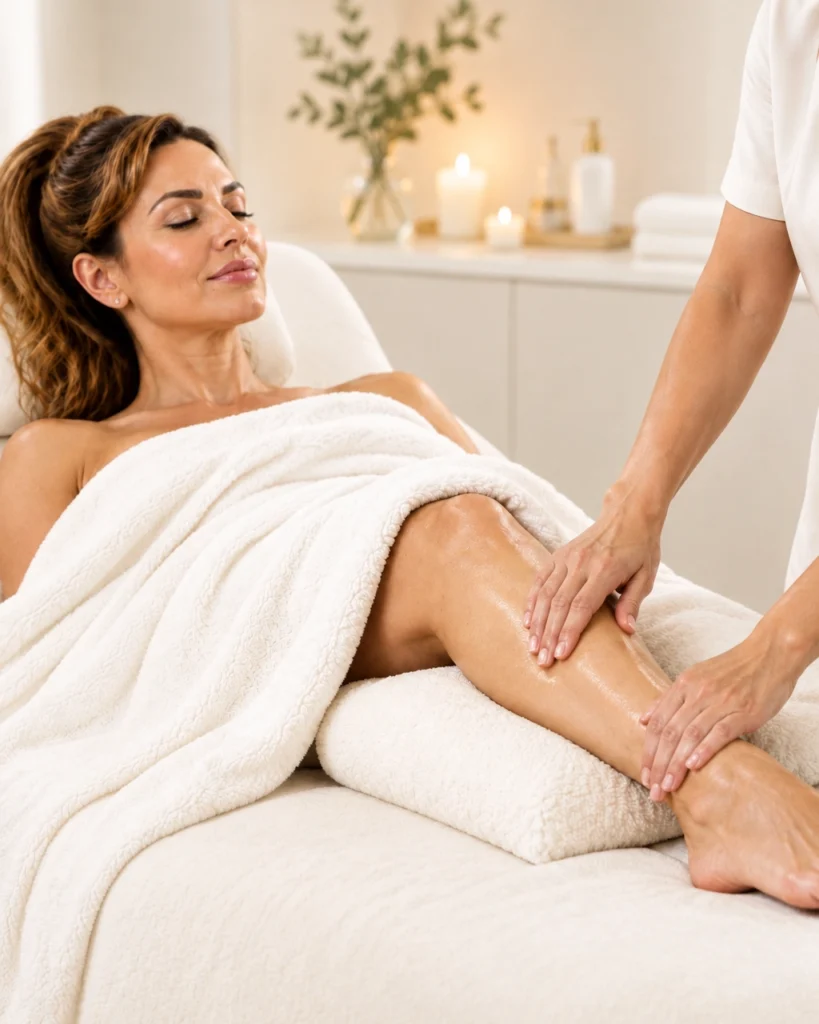
Manual lymphatic drainage is not deep tissue massage. It uses slow, rhythmic, directional movements that gently stretch the skin and encourage superficial fluid pathways.
Harder is not better.
The initial lymphatic vessels sit close to the skin’s surface. Heavy pressure targets muscles and deeper fascia rather than the structures involved in superficial lymph movement. Excessive pressure can also leave tissue irritated and temporarily more swollen.
A sports or deep-tissue massage aims to influence muscle tension, adhesions and deeper soft tissue. Manual lymphatic drainage uses a different pressure, rhythm and direction. It should feel light, precise and relaxing, not painful or bruising.
Compression may support fluid management after assessment. A properly fitted garment can help maintain pressure gradients and reduce the tendency for fluid to reaccumulate. Compression is not automatically appropriate for everyone, however. Vascular status, skin condition, medical history and the reason for swelling must be considered first.
Movement, breathing and elevation are the foundation
Professional lymphatic support works best when daily habits provide the mechanical assistance the system naturally needs.
Build the basics into your routine:
- Walk regularly and break up prolonged sitting.
- Perform gentle calf raises and ankle movements during desk or travel periods.
- Practice slow diaphragmatic breathing, allowing the abdomen and lower ribs to expand.
- Elevate the legs when appropriate, particularly after a long day.
- Avoid clothing or accessories that create unnecessary restriction around the neck, waist, groin or limbs.
- Follow medical guidance regarding compression garments.
These steps are not optional extras. They form the foundation of any responsible fluid-management plan.
How lymphatic support fits into body contouring in Colwood, Metchosin and Sidney
At AGE LESS, electro-lymphatic and synchronized drainage technologies may be used to support fluid movement, comfort and post-treatment recovery within a broader plan. They do not melt fat, rebuild collagen or guarantee permanent inch loss.
The purpose is more specific: to address fluid-related fullness when assessment indicates that congestion contributes to the appearance or sensation of the area.
Measurement comes first. A personalized consultation may consider:
- Circumference and tissue measurements
- Morning versus evening changes
- Skin elasticity and tonicity
- The amount of excess adipose tissue in each area
- Tissue firmness and tenderness
- Previous surgery or procedures
- Medications, hormonal changes and activity patterns
- Whether swelling is symmetrical or one-sided
If excessive adipose tissue is present, targeted inch loss or fat reduction, such as Quantum Reduce with Cryolipolysis and/or Lipo Laser, may need to be performed first. The goal is to reduce underlying volume and support skin adaptation before reassessing the area and addressing cellulite according to its specific type and stage.
Treating an area that is primarily fluid with fat reduction alone can lead to disappointment. The tissue may remain visibly puffy, and the Client may conclude that the treatment failed when the wrong problem was targeted.
Cellulite requires an inside-out and outside-in plan
Cellulite is a female condition managed from the inside out and outside in. There is no one-size-fits-all approach because cellulite presents in three types (soft or flaccid, hard or compact fibrous, and edematous or fluid-retaining) and across four stages.
AGE LESS is the only facility in town offering an extensive array of European Quantum technologies for this layered approach, including:
- ElectroMesotherapy with sterile homeopathic cocktail infusions
- SlimToning with Faradic and Microcurrents
- MicroCavitation with Ultrasounds
- Electrolipolysis
- Targeted FIR wraps
- Synchronized Lymphatic Drainage
Many Clients require a combination of these painless and relaxing therapies for ultimate results. The sequence depends on the tissue. Excess fat may need to be reduced first. Fluid congestion may need support before or alongside structural treatment. Skin laxity may require collagen-focused and surface-tightening work.
Explore the clinic’s cellulite treatment approach for more information about assessment, staging and treatment sequencing.

Lymphatic support does not replace skin tightening
Fluid management can make contours look temporarily cleaner, but it does not correct reduced collagen, dermal thinning or loose skin.
After 40, declining collagen and changes in connective-tissue organization can make the lower body and abdomen appear less firm. Skin tonicity therefore deserves separate attention. Depending on the assessment, a plan may combine lymphatic support with regenerative technologies that encourage collagen remodeling, muscle re-education or surface tightening.
This is the value of a layered European approach: different modalities address different tissue levels rather than forcing one treatment to solve every concern.
What timeline should you expect?
Some Clients notice lighter-feeling legs or reduced puffiness after an initial session. Fluid-related changes can occur quickly, but they may fluctuate.
More consistent improvement generally requires a customized series, especially when swelling, cellulite, localized fat and skin laxity overlap. The number and spacing of sessions depend on the area, the contributing factors and how the tissue responds.
Maintenance also matters. Aging, hormonal changes, travel, prolonged sitting and activity changes continue after the initial plan ends. Customized mini-maintenance packages can help preserve the original investment and support ongoing contour and skin quality.
When swelling is not a cosmetic concern
Persistent or one-sided swelling, swelling with pain, heat, redness, tightness, breathlessness or chest symptoms, sudden swelling in one leg, swelling with fever or after recent surgery, or any unexplained change in weight or abdominal size requires prompt medical assessment.
Do not treat these symptoms as a cosmetic concern. AGE LESS does not diagnose. Consult a physician or appropriate medical professional before considering lymphatic drainage, compression or any Appearance Enhancement treatment.
AGE LESS Laser+Clinic — Trusted by Thousands Since 2000. The clinic has served Clients across the Greater Victoria area, from Saanich to downtown and the Westshore, and the wider Southern Vancouver Island and lower Cowichan Valley, for more than two decades, and since 2024 has welcomed them from its boutique clinic in Esquimalt. Pricing has not changed in 17 years, reflecting a long-standing commitment to transparent, personalized care.

The right first step is assessment
If your body looks different at night than it does in the morning, do not assume the answer is more fat reduction. Ask whether fluid, adipose tissue, skin tonicity, cellulite or several factors are contributing.
A measured, evidence-based plan can then place lymphatic support where it belongs: before, alongside or after targeted contouring and skin-tightening care, not in place of accurate assessment.
For further information, see AGE LESS lymphatic drainage services and the existing guide to lymphatic drainage massage.