
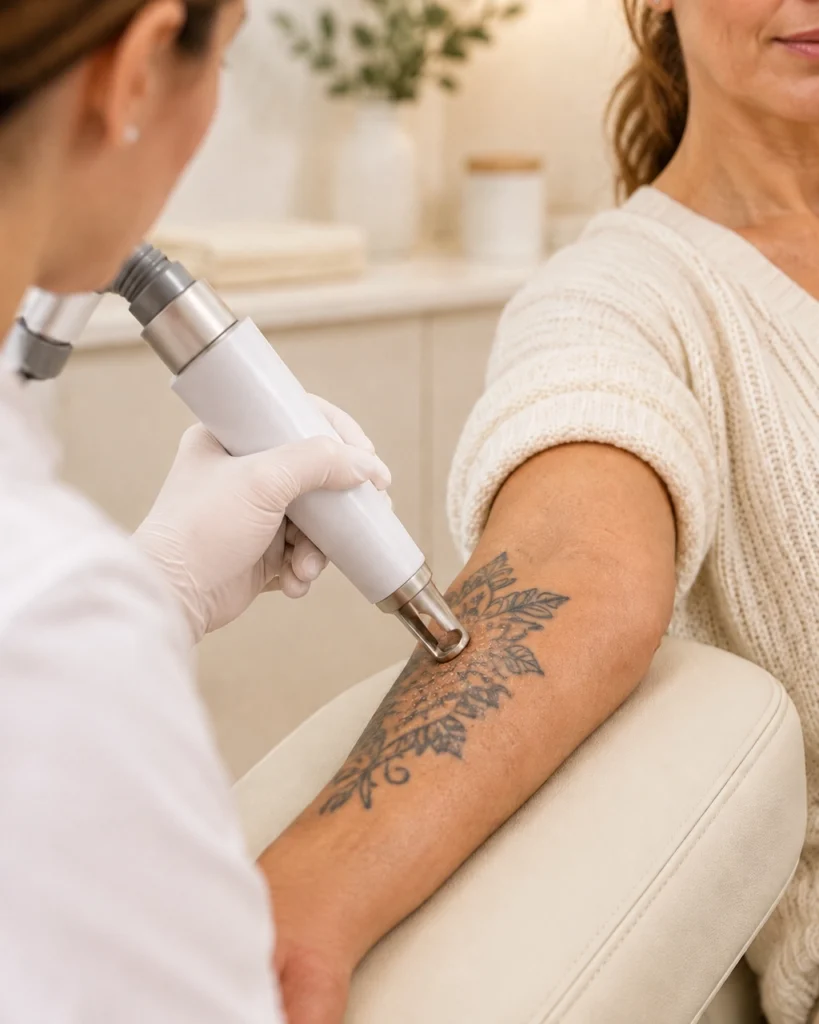

Laser tattoo removal in Victoria, BC is not a fixed-count procedure. The number of treatments depends on how the ink interacts with the laser, the skin and the body’s clearance process.
That is why any provider who promises an exact number of sessions before seeing the tattoo is guessing.
At AGE LESS Laser+Clinic, each tattoo is assessed as an individual clinical project. Ink colour, depth, density, age, layering, placement, skin tone and healing response all influence the treatment timeline. The goal is not to rush pigment removal. The goal is to reduce unwanted ink while protecting the surrounding skin.
AGE LESS Laser+Clinic — Trusted by Thousands Since 2000. The clinic has served Clients across the Greater Victoria area, from Saanich to downtown and the Westshore, and the wider Southern Vancouver Island and lower Cowichan Valley, for more than two decades, and since 2024 has welcomed them from its boutique clinic in Esquimalt. Pricing has not changed in 17 years, reflecting a long-standing commitment to transparent, considered care.
How laser tattoo removal actually works
Tattoo ink sits primarily in the dermis, below the surface layer of the skin. Laser energy does not simply erase it.
Instead, carefully selected light energy is absorbed by the tattoo pigment. Very short pulses fragment larger pigment deposits into smaller particles. The body’s immune system then processes and gradually clears those particles through macrophage activity and lymphatic drainage.
That process continues for weeks after a treatment. The skin may look lighter immediately, but the visible result at the appointment is not the final result. Frosting, or temporary whitening of the treated area, reflects an immediate tissue response. It does not show how much pigment the body will ultimately clear.

The body needs time to complete its part of the process. Treating too soon can increase irritation and pigmentary complications without giving the immune system adequate time to work.
Ink colour determines the wavelength
Different pigments absorb different wavelengths. A professional laser tattoo removal plan may therefore use more than one wavelength for a multicoloured tattoo.
- Black and dark blue generally respond most consistently because they absorb longer wavelengths effectively.
- Red and orange may respond to a different wavelength than black ink, but the result depends on the specific pigment formulation.
- Green, yellow and light green can be more resistant or unpredictable.
- White, flesh-coloured and pale cosmetic pigments require particular caution.
- Some white, pink, beige and cosmetic pigments can darken paradoxically after laser exposure because ingredients such as titanium dioxide or iron oxides may oxidize and become darker.
This is especially important when treating permanent makeup, cosmetic brows, lip liner or flesh-toned camouflage pigment. A conservative test spot may be appropriate before treating the full area.
The useful question is not simply, “Do you offer laser tattoo removal?” Ask which wavelength is appropriate for each colour and how the provider will manage a pigment that reacts unexpectedly.
Ink depth, age and layering change the workload
An amateur tattoo may be lighter and more superficial than a dense professional tattoo. It may therefore respond more efficiently, although no outcome should be assumed from appearance alone.
Professional tattoos often contain more pigment at greater depth. Layered cover-ups contain overlapping ink colours and higher pigment density. A cover-up may begin to reveal the older design as the newer pigment fades, creating a longer and more complex treatment pathway.
Tattooed-over scars also require special attention. Scar tissue may have altered texture, circulation and pigment depth. A recent tattoo must be fully healed before treatment is considered. Treating an incompletely healed tattoo can compromise the skin barrier and increase the risk of an unwanted reaction.
Age helps provide context, but it does not decide the result on its own. An older tattoo may have faded naturally, yet dense pigment, resistant colours or previous treatment can still make it difficult to clear.
Skin tone changes the risk profile
The laser must distinguish tattoo pigment from the melanin in your skin. When the skin contains more melanin, particularly in deeper skin tones or recently tanned skin, the laser energy may interact with the surrounding pigment as well as the tattoo.
A careful plan may include:
- A longer wavelength selected for safer penetration
- Conservative starting settings
- A test spot before broader treatment
- Gradual adjustment based on the skin’s response
- Longer intervals between sessions when needed
- Strict avoidance of tanning before and after treatment
The risk of temporary or persistent hyperpigmentation, hypopigmentation, blistering or textural change increases when the skin is tanned or when settings are too aggressive. Skin tone is not a reason to exclude someone from treatment. It is a reason to plan more precisely.
Placement affects clearance in Victoria, Sidney and Colwood
Tattoo location matters because circulation and lymphatic drainage vary across the body.
A tattoo on the forearm may clear differently from one on the lower leg or ankle. Distal areas, particularly the lower legs and ankles, can respond more slowly because circulation and fluid movement may be less efficient than in areas closer to the torso.
Other placement factors include:
- Whether the tattoo is close to bone
- The thickness and quality of the skin
- Existing scar tissue
- The amount of sun exposure the area receives
- The tattoo’s size and pigment density
A lower-leg tattoo is not automatically unsuitable. It simply requires realistic planning and patience.
Your immune system is part of the treatment
The laser creates the pigment fragments. Your body clears them.
Clearance can be influenced by circulation, immune function, general health, smoking, hydration, medication history and certain medical conditions. Smoking may impair circulation and wound healing. A history of abnormal scarring, pigmentary reactions or poor healing should be discussed before treatment.
This does not mean a Client must meet a rigid health standard. It means the treatment plan should account for the whole person rather than treating the tattoo as an isolated target.
What skin reactions are expected?
Laser tattoo removal commonly produces a short-term inflammatory response. Depending on the tattoo and treatment settings, you may notice:
- Immediate frosting or whitening
- Redness and warmth
- Swelling
- Tenderness or a snapping sensation
- Small blisters
- Pinpoint bleeding
- Scabbing or crusting
- Temporary hyperpigmentation or hypopigmentation
Mild redness, tenderness and crusting that gradually improve can form part of normal healing. The treated area should not be picked, scratched or aggressively exfoliated.
Contact the provider promptly if pain becomes severe or worsens, redness spreads, swelling increases, drainage develops, or the area does not appear to be healing. Fever, facial swelling, breathing difficulty or widespread hives require urgent medical attention.
Any tattoo or skin lesion that is new, changing, bleeding or non-healing requires medical assessment before appearance-enhancing treatment is considered. AGE LESS provides appearance-enhancing clinical esthetics and does not diagnose medical conditions.
Why treatments are spaced weeks apart
Treatment intervals are commonly around six to eight weeks, although the correct interval depends on the tattoo, skin tone, location and reaction.
The surface may appear healed before the immune clearance process is complete. Waiting allows:
- The skin barrier to recover
- Inflammation to settle
- Blisters or crusts to resolve
- Pigment to continue fragmenting and clearing
- The clinician to assess the true response before changing settings
Rushing appointments does not turn a long treatment process into a short one. It can increase the risk of burns, scarring and pigmentary change.
Does tattoo removal hurt more than getting tattooed?
Most Clients describe the laser sensation as a series of quick snaps, similar to a thin elastic band against the skin. The experience varies according to location, pigment density, treatment area and personal sensitivity.
Topical numbing may reduce discomfort for some Clients, but it does not remove every sensation or eliminate the need for appropriate laser settings. Numbing products should be selected and used according to provider guidance. Cooling and clear communication during treatment also support comfort.

How progress should be measured
A professional assessment should include photographs, measurements and a record of the tattoo’s colours, density, age, layering, location and skin characteristics.
Progress should be judged using standardized photographs taken under comparable lighting and positioning. The assessment should consider:
- Reduction in pigment density
- Changes in individual colours
- The condition and texture of the skin
- The presence of residual outlines
- Healing between sessions
- Any temporary or persistent pigment changes
A single dramatic photograph does not establish a predictable outcome. Consistent documentation provides a more honest picture of progress.

Illustrative treatment example of the degree of improvement our expert clinicians can achieve with this protocol. Simulated images are used to protect client privacy and are not photographs of actual clients. Individual results vary.
When laser may not be the best recommendation
Laser treatment has limits. Complete clearance is not always possible, particularly with resistant colours, dense layering, cosmetic pigments, scarred tissue or significant pigmentary risk.
For a small tattoo, surgical excision may be the more direct recommendation, although it creates a scar and requires appropriate medical care. For some Clients, lightening the design sufficiently for a cover-up may be a more practical objective than pursuing complete removal.
A responsible provider should explain these options rather than selling a package that assumes the laser is suitable for every tattoo.
Questions to ask before purchasing a package
Before committing to laser tattoo removal in Victoria, ask:
- Which wavelengths will be used for each ink colour?
- How will my skin tone and any recent tanning affect the plan?
- Is a test spot appropriate?
- Do you see evidence of scarring, layering or unusually dense pigment?
- How many weeks will you recommend between sessions?
- How will you photograph and measure progress?
- What reactions are expected, and who manages complications?
- What happens if white, beige or cosmetic pigment darkens?
- What is the realistic goal: substantial fading, cover-up preparation or maximum possible clearance?
- What alternatives should I consider before purchasing a package?
A bespoke plan should be based on the tattoo in front of the clinician, not on a generic promise.
For more information, see the AGE LESS tattoo removal service and the full AGE LESS services overview. Clients across Greater Victoria, from Saanich, Brentwood Bay and Sidney to downtown and the Westshore, and the wider Southern Vancouver Island and lower Cowichan Valley can begin with an assessment focused on skin protection, measurable progress and realistic expectations.