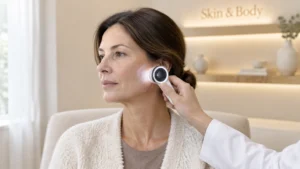

The landscape of medical aesthetics in Victoria is often crowded with “high-volume” mall clinics and discount spas. For the discerning professional in their 40s, 50s, and beyond, these environments rarely align with the biological reality of mature skin. Laser hair removal is not a one-size-fits-all commodity; it is a clinical procedure that requires precision, a deep understanding of hormonal shifts, and a commitment to skin integrity.
On this page
- Precision laser technology
- Why mature skin needs more care
- Clinical safety standards
- The Boutique Chic experience
- FAQs
Serving Esquimalt & the greater Victoria area, AGE LESS Laser+Clinic has long moved beyond the generic narrative. We view permanent hair reduction as a strategic investment in your skin’s health and your personal confidence. Whether you are navigating the subtle textural changes of the 40s or the hormonal surges of perimenopause and menopause that often trigger new, unwanted facial hair, you require a specialized approach.
Precision laser technology {#precision-laser-technology}
Basic IPL is not the gold standard for mature skin. Precision is. At AGE LESS, we use our European Quantum Wave suite, a layered hair-removal platform built around 3 distinct laser wavelengths: the 755 nm Alexandrite, the 808 nm Diode, and the 1064 nm Yag.
Each wavelength has a job. The 755 nm Alexandrite is exceptionally effective for lighter skin and finer to medium hair. The 808 nm Diode is the clinical workhorse, delivering deep follicular targeting with excellent versatility across many skin and hair combinations. The 1064 nm Yag is essential for deeper follicles, darker skin tones, and Clients who require a safer approach around pigment-rich tissue. This is exactly why we offer 3 different laser wavelengths and never force Clients through a competitor-style one-size-fits-all protocol. We calibrate every parameter based on skin colour, hair colour, and hair thickness.
Laser hair removal works through selective photothermolysis. In plain terms, the laser targets one thing specifically: melanin in the hair shaft and follicle. The light converts to controlled heat, that heat damages the follicle’s growth structures, and future growth slows. Repeated treatments weaken more follicles over time. Not every follicle is destroyed in a single session. Some become inactive for long periods, others regenerate weaker, finer hair, and hormones can later stimulate dormant follicles again. That is why maintenance is sometimes recommended even after excellent initial reduction.
The contrast between hair pigment and skin pigment is the single biggest predictor of outcome and of which laser is safe to use. High contrast—dark hair on fair skin—usually gives the strongest response because the target is clear and surrounding skin melanin stays less involved. Medium contrast—dark hair on olive or darker skin—can respond very well with the right laser, especially the 1064 nm Yag or a long-pulse diode approach. This is also where pigmentation problems usually begin when the wrong technology is used. When someone says, “I tried laser and it damaged my skin,” the issue almost always traces back to incorrect laser selection, not to laser hair removal as a category. Low contrast—light, grey, white, or red hair on fair skin—is where laser genuinely struggles because there is not enough melanin to target. That must be disclosed honestly at consultation, not discovered after several paid sessions. All hair-removal lasers require hair with colour, typically dark blonde to black, and the 1064 nm Yag can be used safely on the darkest skin tones provided the hairs being treated are darker still. Even a Client born blonde whose hair has since darkened can still be assessed properly rather than ruled out by assumption.
That calibration matters even more when you are treating mature skin. Aging skin can be thinner, more delicate, more reactive, and more vulnerable to post-inflammatory hyperpigmentation. One laser cannot do every job well. Multiple systems are critical because they allow us to match the energy to the biology in front of us instead of forcing your skin to adapt to a generic device. That is how you protect tissue, reduce unnecessary heat stress, and still get real clearance.
Hair also grows in cycles, which is why one session never clears an area. The cycle includes anagen (active growth), catagen (transition), and telogen (resting). Treatment is only effective during anagen, when the follicle is still attached to the hair shaft and the light can travel down to the target structures. Follicles that were inactive at the time of your appointment were not “missed”; they were simply not treatable on that day.
We also maintain our Quantum ELight IPL system as a specialized back-up for hair removal when a specific presentation calls for it. That gives us flexibility rather than pushing every Client through the same protocol.
Comfort is not an afterthought here. Our technology features chilled contact crystal hand-pieces and high picosecond speeds that keep sessions fast, controlled, and comfortable.
Results build trust. Trust builds legacy. We now treat 2 and 3 generations of families for face and body hair removal because our reputation has been built the right way: speed, comfort, and safety without compromise.

Why mature skin needs more care {#why-mature-skin-needs-more-care}
As we age, our skin undergoes structural and hormonal transformations. For women experiencing maturing skin in the Victoria area, these changes are not just about appearance enhancement; they change how the skin reacts to thermal energy.
- Hormonal Triggers: Menopause and perimenopause can trigger terminal hair growth on the chin, upper lip, sideburns, jawline, and beard area in women experiencing hormonal or hereditary growth. These hairs are often deeper and more resilient than the hair of your 20s. The chin is one of the most frequently requested areas and is often more laser-responsive than expected because the hair tends to be coarser and darker. The challenge is not the laser’s effectiveness on the hair. The challenge is the ongoing hormonal activity that can continue producing new growth. Laser removes existing follicles; it cannot prevent new ones from activating later under hormonal influence. That must be explained before the first session, not after the fifth.
- Skin Sensitivity: Mature skin often has a compromised barrier. High-volume clinics often use aggressive settings to speed up appointments, which can lead to burns, irritation, or pigment disruption on delicate, aging tissue. Facial hair treatment is still clinically appropriate, even in sensitive areas, because the follicle absorbs the energy rather than the surrounding skin, so the effect is localised and controlled. Upper lip, chin, sideburns, jawline, and selected brow areas can all be treated with the correct precautions. Any treatment adjacent to the orbital zone requires proper eye protection and adjusted technique.
- Vascular Fragility: We account for the increased presence of micro-vessels and potential redness in maturing skin, ensuring our laser settings are calibrated to protect your vascular health.
- Variable Response: Laser is not a standardised output system; it is a biological interaction. Hair growth cycles do not follow a shared schedule. Underarms often respond quickly, while facial hair usually needs more sessions, not because the laser is weaker there, but because the percentage of hair in the ideal phase at each appointment is lower and less predictable. Hormones can also outpace the treatment. Where PCOS, thyroid imbalance, medication, pregnancy, or stress are in play, new follicular activity can emerge between or after sessions. Results may plateau mid-course or specific areas may stay resistant no matter how many sessions are completed. That is not the laser failing; it means the underlying driver of growth also needs to be considered. The machine matters less than how it is used. Comparable results are achievable across device types when settings are dialled in correctly. The real variable is operator decision-making: energy levels, pulse duration, cooling methods, and adjustments based on what is actually observed. Timing matters too. Too early and the follicles are not in the right phase; too late and the window has passed. Rescheduled appointments and long gaps do not just add sessions; they reduce the effectiveness of the sessions that do happen. Every body area responds differently, so a full-body plan will always produce uneven results. Measure your own trajectory, not someone else’s. The useful question is whether your session five looks better than your session two.
For facial areas specifically, approximately 80% hair reduction across an average of five sessions is a realistic benchmark when the hair and skin contrast is suitable and the course is completed properly. Facial hair regret almost always traces to a mismatch between the Client’s skin and hair type and the laser used, or to a course that ended too early. Both are consultation failures, not treatment failures.
After treatment, the timeline is straightforward. Skin may look pink or feel warm for a few hours, similar to mild sun exposure. Small bumps around follicles are normal and usually settle quickly. Most Clients return to normal activity the same day. Over the next one to three weeks, treated hairs gradually shed from the follicles. This is normal and a sign the treatment is working. It can look like stubble coming through, but it is not regrowth. By sessions four and five, most Clients notice significantly reduced density and a finer texture in what does return.
It is also useful to understand how laser compares with other methods. Shaving is quick and painless but requires constant upkeep, with regrowth within days. Waxing lasts longer but involves repeated pulling and irritation over time, and ingrown hairs are a common reason Clients switch. Threading can feel surprisingly uncomfortable on delicate facial areas because every hair is manually removed. Electrolysis is truly permanent follicle by follicle and highly effective, but significantly slower because each follicle is treated individually. IPL is not technically a laser but a broad-spectrum light system; professional laser systems are generally more targeted and powerful. Laser hair removal also uses entirely different settings and wavelengths from tattoo removal, because the two technologies target different structures in the skin.
For men and upper-body grooming, craft matters. Specialized methods are performed so men do not end up with straight demarcation lines of remaining hair on the upper arms, neck, or shoulders, but rather a naturally feathered effect that blends treated areas into untreated ones.
Clinical safety standards {#clinical-safety-standards}
Your safety is not negotiable. In British Columbia, the Public Health Act and Personal Service Establishments (PSE) Regulation sets the baseline for clinical operations. However, at AGE LESS, we view these regulations as the bare minimum, not the goal.
Our protocols for sterilization, operator expertise, and laser safety exceed provincial requirements. The most common short-term effects are temporary redness, mild swelling, and a flushed feeling for a few hours. Less common effects include temporary pigmentation changes, mild irritation, and blistering if incorrect settings are used. Scarring is very rare when laser hair removal is performed properly with appropriate technology for the skin tone. Treated skin is also temporarily more sun-sensitive, which is why consistent SPF between sessions matters. Sun exposure before and after treatment is a specific risk factor for temporary darker or lighter patches, particularly on darker complexions.
Practical timing matters too. Facial sessions usually involve one to five minutes of actual laser time, with ten to fifteen minutes for the full appointment including preparation. Eye protection is worn throughout, and numbing cream is available for sensitive areas. Most body sessions run under 30 minutes depending on area size.
When you enter our Boutique clinic, you are entering a controlled, clinical environment where every parameter, from the chilled cooling tips on our lasers to the atmospheric hygiene, is meticulously managed. We do not just follow the rules; we set the standard for clinical excellence in Victoria and Esquimalt.
The Boutique Chic experience {#the-boutique-chic-experience}
To provide our VIP Clients with utmost comfort at our Boutique Clinic, we have intentionally designed AGE LESS Laser+Clinic to be the antithesis of the typical brightly lit, bustling med-esthetic facility. Our “Boutique Chic” aesthetic, featuring pale shell pink white walls, soft cream, oat meal and soft taupe grounding tones, with crisp white furnishings and the shimmer of crystal and soft gold accents create an gentle atmospheric environment that our devoted Clients truly appreciate and enjoy.
You are not a number in a waiting room. You are a Client receiving bespoke care in a private, elegant environment. From our laboratory-chic Mixology Bar, where we prepare clinical-grade topicals for post-treatment care, to the quiet confidence of our treatment suites, every detail is curated for your comfort and results.
FAQs {#faqs}
Is laser hair removal safe for skin of color as it ages?
Absolutely. Skin of colour and mature skin both demand disciplined laser selection, not guesswork. This is where a multi-wavelength platform matters. We choose between the 755 nm Alexandrite, 808 nm Diode, and 1064 nm Yag based on your skin tone, pigment level, hair depth, and follicle density. For darker skin tones (Fitzpatrick IV-VI), the 1064 nm Yag is often critical because it treats deeper while minimizing unnecessary surface pigment disruption. That is how we protect aging skin, reduce the risk of hyperpigmentation, and deliver safe, intelligent clearance.
How many sessions will I actually need?
While you will usually see a reduction 2 to 3 weeks after the first visit, mature skin and hormonally influenced areas typically require 6 to 8 sessions for a strong initial course, with facial areas often needing more vigilance because new hairs can continue to activate. This is due to the staggered nature of hair growth cycles. Lasers can only cauterise the blood supply to each hair when those hairs are in the anagen growth phase. Hairs not affected at one visit were often in catagen or telogen, not “missed.” Each body area cycles at different rates, which is why patience, timing, and consistency matter.
Important Note on Hair Color
All hair-removal lasers require hair with colour—typically dark blonde to black. With our 1064 Yag laser, we are able to work safely on the darkest skins as long as the hairs being treated are darker still. No laser for hair removal will work on white, silver, grey, very light blonde, or red hair, because there is insufficient pigment for the light to target. This is also why pre-laser hair reduction treatments require hair to be shaved, not waxed, threaded, or tweezed, prior to your session. For treatments to succeed, all roots need to be in place as conduits for the light energy to travel down the remaining hair shaft inside the skin and cauterise the blood supply to each hair bulb.
Does it hurt?
Our advanced European technologies use integrated contact cooling. Most Clients describe the sensation as a quick warm snap or a light elastic-band flick followed by warmth. The pulse lasts a fraction of a second, and the cooling calms the skin immediately. Anticipation is usually worse than the treatment itself.
Does Laser Hair Removal Hurt?
Usually less than expected. Comfort varies by area because nerve density, hair thickness, and treatment density all differ. Legs tend to feel mild to moderate. Underarms are often more noticeable, but the treatment is very fast. Facial areas are usually mild, with the upper lip being the most sensitive because of nerve density. Bikini and Brazilian areas are more sensitive but still manageable. Back and chest can feel warmer because the hair density is often higher. The first session is usually the strongest because the hair is thickest; comfort generally improves as the hair thins.
Is Laser Hair Removal Permanent?
Laser hair removal is classified as permanent hair reduction, not guaranteed permanent hair removal. After a full course, a typical range is roughly 70–90% less hair. Whatever remains usually grows back finer, softer, and slower. Some follicles stop entirely. Others can produce finer regrowth later, especially if hormones change.
How Long Does Laser Hair Removal Last?
Results can last many months to several years depending on the area treated, hair type, hormonal activity, skin tone, and how consistently the course was completed. Maintenance once or twice a year is common, especially on hormonally influenced facial areas.
Can Laser Hair Removal Cause Cancer?
No. Laser hair removal uses non-ionising light, which is fundamentally different from the ionising radiation associated with cancer risk, such as UV exposure and X-rays. There is no credible scientific evidence linking cosmetic laser hair removal to cancer. The treatment targets surface-level follicles.
Who Is a Good Candidate for Laser Hair Removal?
The best candidates usually have strong contrast between hair and skin, because that gives the laser a clearer target. Treatment is less effective on white, grey, very light blonde, or red hair because there is insufficient melanin to target. Results can also be affected by PCOS, hormonal imbalance, active skin irritation, and photosensitive medications. Pregnant individuals are usually advised to postpone because hormonal fluctuations can change both skin sensitivity and growth patterns.
How Should I Prepare for Laser Hair Removal?
Shave the area 24 to 48 hours beforehand. Avoid waxing, plucking, threading, or tweezing for 4 to 6 weeks before treatment. Avoid sun exposure and tanning for at least two weeks, and pause strong retinoids or active acids if instructed. Shaving matters because the follicle must stay intact beneath the skin while surface hair is reduced so it does not absorb heat unnecessarily. Hair to be treated must be shaved, never waxed, threaded, or tweezed—all roots need to be in place as conduits for the light energy to travel down the remaining hair shaft and cauterise the blood supply to each hair bulb.
What Should I Avoid After Laser Hair Removal?
For the first 24 to 48 hours, avoid intense workouts, saunas, excessive heat, direct sun exposure, and harsh skincare. SPF is non-negotiable on treated skin because it is temporarily more sun-sensitive.
Invest in Your Body: The Next Step
If you are tired of the repetitive cycle of temporary hair removal and the impersonal nature of high-volume facilities, it is time for a change. You deserve a relaxing, clinical environment that matches your professional standards and respects your skin’s biological needs.
Take the first step toward clinical excellence.
Contact us today for your Initial Complimentary Assessment. We will use our advanced diagnostic tools to assess your skin and hair type, creating a bespoke plan tailored specifically to you.
📞 Call 236 485 7826 to book your appointment at our Victoria location.