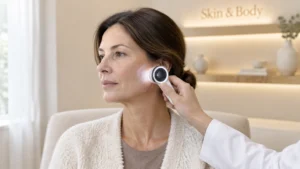


Skin boosters have become one of the most talked-about skin-rejuvenation topics in 2026. The appeal is easy to understand: many people want skin that looks more hydrated, smooth and resilient, without changing the features that make their face their own.
But “skin booster” is an umbrella term, not a single treatment. It can refer to different injectable materials and approaches, with different purposes, evidence, risks and timelines. The name alone does not tell you whether a particular option suits your skin, or whether it is appropriate for your goals.
Start with the outcome you want, not the trend. For Clients exploring skin boosters in Victoria, BC, a careful assessment and clear discussion of evidence are more useful than a standardised protocol.
What does “skin booster” mean?
Skin boosters are generally discussed as treatments intended to improve skin quality rather than reshape facial features. Depending on the product and technique, the goal may be better hydration, texture, elasticity or the appearance of fine lines.
The term most commonly refers to injections placed within the skin. That makes it different from topical skin care and from treatments designed primarily to add volume or alter contours. It is also different from biostimulators, a broader category of materials intended to encourage gradual tissue remodelling.
The terms can overlap in marketing, so ask what is actually being proposed. What material is used? Where is it placed? What specific result is it intended to support? How many Sessions are proposed, and what is known about duration and risks?
This article is educational. AGE LESS Laser+Clinic focuses on non-invasive regenerative care: rather than injectable skin booster procedures, the clinic delivers hydration, nourishment and regenerative actives through science-backed, non-invasive European infusion technologies, completed with professional low-level laser sessions. Injectable procedures fall within a medical protocol category and should be discussed with a medical professional.
Why interest is growing
Skin can change with age, hormonal shifts, sun exposure, environmental conditions and individual biology. Some people notice more dryness or fine lines; others are concerned about texture, elasticity or a loss of radiance. Those concerns do not all have the same cause, so they do not necessarily call for the same strategy.
Skin boosters have attracted attention because they focus on skin quality, a concern that can sit between daily hydration and more structural approaches to rejuvenation. They are also part of a wider conversation about skin longevity: how to support skin health over time rather than chase one dramatic, temporary change.
That conversation needs careful framing. Research can report improvements in selected measures of skin quality over a study period. It does not establish that these procedures stop biological ageing, prevent future changes or extend the lifespan of skin. In this context, “longevity” should mean thoughtful, ongoing care, not a proven promise to slow ageing.

The evidence: promising, but not one-size-fits-all
A 2026 review in the Journal of Cosmetic Dermatology examines a wide range of products and methods described as skin boosters. It discusses hyaluronic acid, polynucleotides, platelet-rich plasma, biostimulatory materials and emerging approaches. The review reports potential benefits across hydration, texture and elasticity, while noting that studies use different products, techniques, treatment schedules and ways of measuring results. That variation makes direct comparisons difficult. Read the review.
The category is diverse; the evidence is uneven. Here is a practical overview:
- Hyaluronic acid (HA): HA attracts water, which is why some injectable HA approaches are positioned around hydration and skin quality. The 2026 review describes promising short-term findings, but duration varies. It reports effects averaging around six months after a typical three-Session course; this is a study-level observation, not a guarantee for an individual.
- Polynucleotides and PDRN: These are being studied for effects on skin texture and elasticity. Early findings are of interest, but formulations and protocols are not standardised, and larger, stronger studies are needed before making broad claims.
- Biostimulatory materials: Calcium hydroxylapatite, poly-L-lactic acid and polycaprolactone are generally discussed as options for gradual tissue remodelling rather than immediate hydration. Their proposed effects develop over time. They are not interchangeable with HA, and they require informed discussion of technique and potential complications.
- Combination approaches: Researchers are also examining combinations of materials. Some early reports are promising, but small or uncontrolled studies cannot establish that a combination works better than a well-chosen single approach.
Evidence quality matters. A change in a measurement such as hydration or dermal thickness does not always translate into a noticeable benefit for every person. Ask what outcome a study measured, how many people took part, how long they were followed and whether the product and protocol match what is being recommended to you.
Hydration injections are not the same as biostimulators
People searching for skin hydration injections in Victoria may encounter several categories under the same “booster” label. An HA-based injection may be discussed primarily for hydration. A biostimulator is more often described as encouraging gradual structural change. Other materials may have different proposed mechanisms and evidence.
The distinctions matter because the timeline, treatment plan and risk profile can differ. An option aimed at hydration is not automatically the right option for texture or firmness. Nor does “regenerative” mean risk-free or permanent.
Match the approach to the concern. A professional should explain the proposed material in plain language, what it is intended to do, what the evidence can and cannot show, and what alternatives exist, including choosing no procedure.
Questions to ask before considering an injectable
Injectable procedures deserve careful, unhurried consideration. Before deciding, ask:
- What exact product or material is being proposed, and what is its intended use?
- What skin concern is it meant to address, and what will it not change?
- What evidence supports this approach, and how closely does that evidence match my situation?
- Who will perform the procedure, and what training and experience do they have?
- What are the expected discomfort, recovery, risks, follow-up needs and total number of Sessions?
- What should I do if I have a concern after the procedure?
In Canada, Health Canada provides consumer information on cosmetic injections. Its guidance is a useful starting point for understanding that injectable products and procedures require appropriate oversight. Ask the provider how they verify the product and explain its risks.
A bespoke approach looks beyond one product
A skin concern rarely exists in isolation. Before choosing an Appearance Enhancement treatment, consider your skin history, current routine, comfort level, priorities and the specific change you hope to see. A medical professional can discuss whether an injectable is suitable, whether a non-invasive option is more appropriate, or whether you should seek medical advice first. At AGE LESS, the needle-free path is explored first: hydration and regenerative actives are delivered through science-backed, non-invasive European infusion technologies that keep the entire experience comfortable and non-surgical.
AGE LESS differs from high-volume clinics by emphasising individual assessment and bespoke guidance rather than relying on standardised protocols. Its wider regenerative-technology approach considers that different modalities may address different tissue levels, for example, muscle re-education, collagen synthesis and surface tightening. That does not mean everyone needs multiple Treatments. Layering should be purposeful, not automatic.
If you are exploring advanced skin rejuvenation in Victoria or Esquimalt, you can learn more about the clinic’s assessment-led process in Your First Consultation at AGE LESS. The clinic’s laser skin-care articles offer further information about its broader skin-care topics. These resources describe AGE LESS’s general approach; they are not a claim that the clinic provides injectable skin boosters.
Think in terms of an informed investment
A procedure is an investment of time, money and attention. Results vary, and no article can predict your individual response. A visible change after an initial Session does not guarantee a lasting result; some approaches involve a customised series, and maintenance may be discussed depending on the treatment, response and evolving goals.
Ask for a realistic plan before you commit. Clarify what improvement would look like, when it should be assessed, what the next step would be if results are limited, and whether ongoing Sessions are likely. You should have time to consider the information. A thoughtful decision can include waiting, choosing a different approach or deciding not to proceed.
For Clients in Victoria, Esquimalt, Langford and Sidney, the most useful first step is not chasing the newest label. It is finding out what your skin needs, understanding the options and choosing a path that fits your priorities.
Skin boosters are worth understanding, not following blindly. Let evidence, suitability and a clear conversation guide your next move.
Serving Esquimalt & the greater Victoria area for over 20 years.
About the author
Mari Silva, Founder, Author & Resident Expert
Creator of the CosMEDermal Rx Bio-Active Skin Care Mixology.
Frequently asked questions
What are skin boosters?
Skin boosters is a broad term for approaches, commonly injectable, intended to improve aspects of skin quality such as hydration, texture or elasticity. Products and evidence vary, so ask which specific material and goal a provider is discussing.
Are skin boosters the same as dermal fillers?
Not necessarily. Skin boosters are generally discussed as treatments for skin quality, while dermal fillers are commonly used to add volume or alter contours. Terminology can overlap, so confirm the product, intended use and treatment plan with a qualified medical professional.
How long do skin booster results last?
Duration depends on the product, protocol and individual response. A 2026 review reports an average effect of around six months after a typical three-Session course of HA skin boosters, but this is not a guarantee or a timeline that applies to every product or Client.
Are skin booster injections suitable for everyone?
No. Suitability depends on individual circumstances and the proposed product and procedure. A qualified provider should review relevant history, explain risks and alternatives, and advise whether an injectable procedure is appropriate.
Does AGE LESS offer skin booster treatments?
AGE LESS focuses on bespoke, assessment-led skin and body care delivered without needles. Rather than injectable skin booster procedures, the clinic offers science-backed, non-invasive European infusion technologies that deliver hydration and regenerative actives into the skin, completed with relaxing professional low-level laser sessions. Injectable procedures fall within a medical protocol category and can be discussed with a medical professional; your regenerative skin plan continues here either way.
A note on language: these are not spa-style pampering technologies. They are science-backed, non-invasive European infusion technologies, designed around evidence and clinical assessment.