

Evil #6: Hormonal Ghosting : The Endocrine Shift
One morning, your face looks familiar. The next, it appears thinner, drier and less resilient. Fine lines seem deeper. Your jawline feels less defined. Products that once worked suddenly seem to do very little.
This is Hormonal Ghosting: the quiet endocrine shift that often becomes visible after 40.
It can feel sudden, almost overnight. In reality, the biology has usually been changing for years. Estrogen and progesterone begin fluctuating during perimenopause, then decline more decisively as menopause approaches and passes. As that hormonal support drops, collagen production, hydration, circulation and tissue repair all begin to change.
That is why the face can seem to change first, even though the story is much bigger than the face.
Topical skincare still matters, but it cannot solve a whole-body collagen story on its own. Moisturisers can support the barrier. Retinoids can encourage surface renewal. Antioxidants can help defend against environmental stress. None of them can fully replace the structural support that hormones once provided from within.
Estrogen: your master collagen protector
Estrogen is not simply a reproductive hormone. It is one of the body’s key protectors of collagen, elasticity and tissue resilience.
Collagen is the structural protein that helps keep skin firm, tendons supple, joints cushioned, muscles supported, bones stronger and tissues more capable of repair. When estrogen levels decline, the body does not just “age” in a vague sense. It loses some of the hormonal signaling that helps maintain strength, flexibility and recovery across multiple systems.
This is why hormonal decline can show up as thinner skin, slower healing, reduced elasticity and a softer, less supported look. It is also why the shift often feels deeper than appearance alone. The framework itself is changing.
Why the face shows it first
The face is often where women notice hormonal decline first because skin is both highly visible and richly dependent on collagen, hydration and circulation.
When that support starts to weaken, the signs appear quickly: dryness, crepiness, fine lines that seem sharper, a duller tone, a less defined jawline, and skin that no longer bounces back the way it once did.
The change may look cosmetic. It is not merely cosmetic. The face is simply the most public place where a deeper structural shift becomes impossible to ignore.
The wider-body story behind the face
The same collagen chemistry that keeps facial skin firm also supports joints, tendons, bone, heart tissue, muscles, the bladder and the body’s deeper connective structures.
That is why the hormonal shift that shows on the face can also show up as stiffer joints, frozen shoulder, carpal tunnel, aching hips, sore knees, reduced muscle resilience and a weaker sense of physical stability overall. The system softens because its core structural protein is under-supported.
For many women, this becomes especially clear in the first years after menopause, when estrogen can drop sharply. What looks like a list of separate issues is often one connected story: less hormonal protection, less collagen support, less resilience.
This is the part too many conventional conversations miss. Menopause is not just a cycle change. It is a whole-body structural transition.
A more complete and less outdated conversation
This is why Hormonal Ghosting deserves a broader lens. It is not vanity. It is not overreaction. It is not “just aging.”
It is a shift in tissue biology that first becomes visible on the face and then often reveals itself in comfort, mobility, recovery and confidence. When women understand that connection, they can make better decisions instead of chasing isolated symptoms one by one.
For many women over 50, correctly dosed hormone replacement therapy to help rebalance what has been lost may be a worthwhile first line of defense to discuss with a qualified prescribing clinician before additional medications are layered on top. The point is not to treat hormones casually. The point is to stop ignoring physiology.
The AGE LESS Quantic, Regenerative Approach
At AGE LESS, skin is viewed through an inside-out, regenerative lens. That does not replace medical care. It strengthens the conversation by recognising that your face is part of a larger biological system.
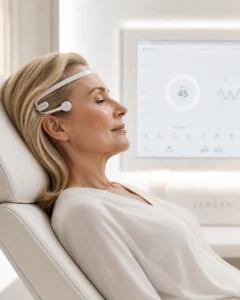
A personalised plan may include clinical skin support, collagen-focused technologies, 3D Skin & Body Scans and wellness modalities that help clients understand how stress, tissue quality, hydration and hormonal shifts can influence how they look and feel.
For visible skin concerns, the QUANTUM Hydra-Skin PRO System may form part of a layered protocol to restore hydration and luminosity. Other advanced technologies may be selected according to skin quality, sensitivity, tissue laxity and long-term goals.
Layered technologies outperform isolated quick fixes because they address tissue at more than one level. The goal is not to over-treat. The goal is to choose the right support, in the right sequence, so the skin and the person behind it are treated with precision.
Improvements are often visible from the first visit, then continue to develop over the following months as collagen remodelling and consistent home care take effect. Maintenance remains essential. Aging does not stop, but strategic support can change how your tissues respond to it.

A personal note from Mari
As a woman past her fifties with optimal biometrics, I did not arrive here by treating aging as a cosmetic issue alone. I had to step away from the old 24/7 work model and build a more intelligent approach to health: one grounded in customized skincare, nutrition, supplementation, movement, recovery and hormonal balance.
That is why the AGE LESS philosophy has always been inside-out, outside-in. Your skin reflects the whole person. It deserves sophisticated, personalised treatment, but it also deserves context.
Meaningful work, ongoing evidence-based education, yoga, swimming, resistance training, portrait painting and a serious love of gardening all help keep me engaged, mobile and present. That perspective continues to shape how the clinic supports clients: not with generic fixes, but with elegant, individualized care designed to help you stay active, vital and fully invested in your life.

What to do if your skin has changed suddenly
Start with information, not panic.
If your face seems to have changed overnight, widen the lens. Look at skin, yes, but also at sleep, stress, joint comfort, muscle tone, cycle changes, bladder symptoms, recovery, energy and overall resilience. What shows up on the face is often part of a broader hormonal picture.
Discuss your symptoms with a qualified healthcare provider, and then consider a bespoke assessment with an experienced regenerative practice that looks beyond one isolated treatment. A clinic that only sells one solution will usually recommend one solution. A bespoke clinic examines the pattern and builds a plan around your biology, comfort and schedule.
AGE LESS Laser+Clinic has been serving Esquimalt & the greater Victoria area for over 20 years with personalised European-style clinical esthetics and wellness support.
You do not need to chase every new wrinkle. You need a clearer understanding of what changed, and a strategy that supports the whole system as well as the surface.