
Discover AGE LESS’ personalised post-summer pigment reset in Victoria BC, combining advanced skin rejuvenation, melasma care and regenerative skin treatments.
After a Vancouver Island summer, your skin may show more than a tan. Sun spots, melasma, freckles, post-inflammatory marks and uneven tone often become more visible in early autumn, when the accumulated effects of UV exposure finally catch up with the complexion.
October is the ideal time to respond, without panic and without treating every brown mark as the same problem.
A post-summer pigment reset is not a single brightening facial. It is an assessment-led, layered and regenerative program designed around where pigment sits, what triggered it and how your skin behaves. The goal is not to promise a perfectly cleared face. The goal is to help your skin return to a calmer, more even baseline while supporting healthy cell turnover, barrier function and collagen quality.
Pigment is a pattern, not a surface stain
Pigment sits at different depths. Epidermal pigment is closer to the surface and often responds differently from dermal pigment, which sits deeper and may require a slower, more conservative strategy.
That distinction matters. One-size-fits-all lightening approaches disappoint because they treat visible colour without understanding its source.
Sun spots and cumulative exposure
Sun spots, also called solar lentigines, are visible signs of cumulative UV exposure. They develop gradually, but a season of sailing, golfing, gardening, hiking or walking the coast can make them appear darker and more numerous.
At AGE LESS, this cumulative exposure is known as the Solar Tax. It compounds year over year, even when individual periods in the sun seem harmless.
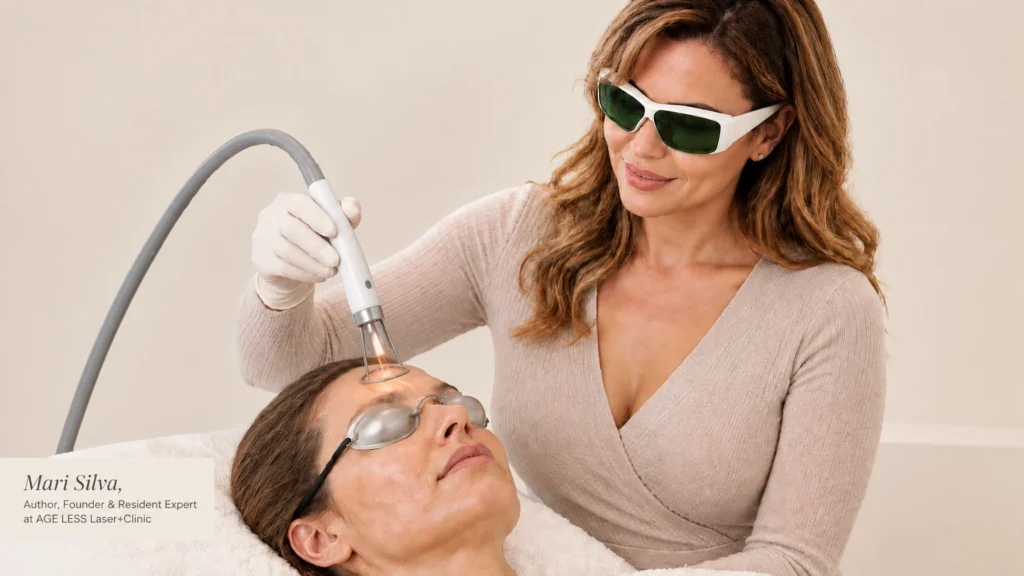
This is also where the clinic’s Bright & LUMINOUS Duet often becomes especially relevant. It combines two non-ablative fractional European laser technologies that can be used separately for a specific target or paired when post-summer skin is showing both uneven pigment and textural decline together.
Learn more about sun spot removal and sun damage support in Victoria, BC.
Melasma requires restraint
Melasma is not a simple sun spot. It is a reactive, hormonally influenced pigment pattern that can be affected by UV exposure, visible light, heat, hormonal changes, stress and inflammation.
Treating melasma aggressively or indiscriminately can make it worse. That needs to be said plainly.
Melasma requires a conservative, carefully reviewed Approach. The correct plan may include topical clinical-grade brightening support, barrier repair, selected light-based Sessions and ongoing protection. It may also require adjusting the plan when your skin signals that it needs more time. Within that framework, the Thulium side of the clinic’s Bright & LUMINOUS Duet may be selected cautiously when appropriate, because the aim is to support a more even-looking complexion without treating melasma as a stain to be erased.
Read more about personalised support for melasma in Victoria BC.
Post-inflammatory hyperpigmentation
Post-inflammatory hyperpigmentation develops after inflammation. Acne, insect bites, waxing, shaving irritation and aggressive at-home products can all leave pigment behind.
The answer is not to scrub harder. Continued irritation can maintain the cycle. A successful protocol first reduces unnecessary inflammation, then introduces pigment-supportive care at a pace your skin can tolerate.

Why the assessment comes first
A proper pigment Strategy begins with observation, not a menu of Sessions.
During an Initial Evaluation, AGE LESS clinicians review your pigment pattern, skin history, sun exposure, hormonal context, current products, previous procedures and the condition of your skin barrier. The clinic’s 3D digital assessment tools add another level of detail, helping track changes in tone, texture and surface quality over time.
The assessment helps distinguish between:
- Epidermal, dermal or mixed pigment
- Sun spots, melasma, freckles or post-inflammatory marks
- Pigment combined with redness, texture change or collagen loss
- Skin that is ready for corrective work and skin that needs calming first
This is how advanced skin rejuvenation becomes personalised rather than predictable.
High-volume clinics often move quickly from concern to procedure. AGE LESS takes a different route. The focus remains on bespoke, evidence-based and regenerative guidance in a calm European-style environment, not a generic med-spa formula.
A layered approach for tone, texture and skin quality
Pigment rarely exists in isolation. The complexion may also show roughness, fine lines, enlarged pores, redness or reduced firmness. After summer, dehydration often sits in that picture too. Sun-damaged skin is rarely only a colour concern. It is usually pigment, texture and dehydration presenting together, which is exactly why a duet approach often suits post-summer skin better than a single-modality brightening Session.
Depending on your assessment, a personalised protocol may include:
- Bright & LUMINOUS Duet, the clinic’s lead technology for post-summer sun damage. It is a duet of two non-ablative fractional European laser technologies: Thulium, which addresses sun damage, pigment and melasma conservatively, and Erbium, which addresses texture including lines, pores and surface scarring.
- These two technologies can be used separately when the goal is more specific, or combined when pigment and texture should be addressed together on the face or body.
- In general terms, this duet works by creating microscopic thermal channels that trigger the skin’s own repair and remodelling without surface damage, supporting collagen quality, hydration quality and a more even-looking tone.
- Q-Switched Pico YAG, selected with different heads and programs for pigment, texture and surface tightening.
- IPL-style photopulsation for skin rejuvenation and corrective tone work when appropriate for the pigment pattern.
- Light-based modalities targeting several chromophores at different tissue depths, supporting a more comprehensive approach to uneven colour.
- Topical clinical-grade brightening support to help regulate pigment production and maintain progress between Sessions.
- European Regenerative Technology and Quantum Synchronized Energy approaches where combining modalities can support the skin from the inside out and outside in.
The right combination may address pigment production, surface renewal, collagen quality, hydration quality and barrier function together. It is not about adding every available modality. It is about choosing the few that make clinical sense for your skin.
October to March is the working window
From October through March, UV intensity is generally lower across Vancouver Island, daily sun avoidance becomes easier and there is more time to complete a considered series before the following summer.
That does not make winter a permission slip to ignore sunscreen. Daily broad-spectrum protection, shade, hats and sensible outdoor habits remain essential. Melasma in particular can respond to visible light and heat as well as UV exposure.
The clinic’s seasonal Undoing Summer Protocol window closes on 14 October 2026 for anyone who wants to begin this season. A personalised program can also begin at any point during the darker months, based on your skin’s condition and your schedule.
The objective is steady improvement, not a rushed seasonal rescue.
What clients often get wrong at home
Pigment concerns often worsen when the home routine becomes too aggressive. Common mistakes include:
- Over-exfoliating to force faster turnover
- Layering several strong brightening actives at once
- Using irritating products on already reactive skin
- Treating melasma like a stain that needs to be erased
- Going outdoors daily without adequate protection
- Stopping all maintenance once the complexion looks clearer
A streamlined routine usually performs better than a crowded one. Your clinician can determine which products support the professional Strategy and which should be paused.
The inside-out side of pigment management
Skin does not operate separately from the rest of the body. Sleep quality, inflammation load, hormonal context, nutrition and antioxidant support can all influence how resilient and reactive your skin feels.
This does not mean every client needs extensive testing. Where the history suggests a genuine reason, saliva hormone testing or a body stress assessment may help add context. These tools should clarify the Strategy, not become automatic add-ons.
The outside-in side includes barrier support, carefully selected topical care and appropriate light-based Sessions. The inside-out side includes the conditions that help your skin recover and remain stable. This is the foundation of skin longevity in Victoria BC.
A considered initial series, not a sales target
Our lead clinician puts the approach simply:
“We recommend a considered initial mini series based on our experience with different skin types and pigment conditions. Everyone responds at a different rate, so we prefer to build up as needed rather than take more of a client’s money up front. Once we have seen how the initial series has gone, and understood the response and desired outcome, we can decide whether more Sessions are appropriate.”
This approach protects your investment and keeps the plan accountable. Skin can look fresher and more even after the first Session, but deeper pigment behaviour, collagen quality and long-term stability develop progressively.
If you reach the zenith of what can be achieved non-surgically and want further improvement, the ethical next step may be a referral to a good surgeon. Knowing when to stop is part of expert care.
Once your initial progress is established, a personalised maintenance plan can help protect what your skin has achieved and support it as it continues to change.
Frequently asked questions
Why is autumn a good time to address post-summer pigmentation?
Autumn brings lower UV intensity, easier sun avoidance and enough time to work through a considered series before the following summer. It also allows the skin to recover from prolonged seasonal exposure before more corrective Sessions are introduced.
How do you know whether pigmentation is melasma, a sun spot or post-inflammatory hyperpigmentation?
An Initial Evaluation reviews the pigment pattern, colour, location, history and possible triggers. AGE LESS also uses 3D digital assessment tools to examine changes in tone and texture. Melasma, sun spots and post-inflammatory hyperpigmentation require different Approaches.
Can melasma be treated aggressively for faster results?
No. Melasma is a reactive, hormonally influenced pigment pattern, and aggressive or indiscriminate treatment can make it worse. A conservative, personalised Strategy is safer and more appropriate.
How many Sessions will I need for a pigment reset?
The recommended number depends on your pigment depth, skin condition, triggers and desired outcome. AGE LESS usually recommends an initial mini series, reviews your response and only suggests additional Sessions when they are justified.
What happens during the complimentary Initial Evaluation?
Your clinician reviews your goals, skin history, pigment pattern, current routine, sun exposure and relevant health context. The evaluation may include 3D digital assessment tools and helps determine whether an Appearance Enhancement Session, topical support or a staged combination Approach is appropriate.
Start with an informed plan
Pigment responds best to consistency, accurate assessment and realistic expectations. Autumn gives you the right working window, but the right Strategy gives you the lasting advantage.
AGE LESS Laser+Clinic has served Esquimalt and the greater Victoria area for over 20 years. Your Transformation Destination Since 2000, the clinic provides personalised advanced skin rejuvenation and regenerative skin treatments for discerning Clients who want more than a generic seasonal fix.
Begin with a complimentary Initial Evaluation.
Call 236 485 7826
Text 250 514 7032