
WORDPRESS BLOG POST, AGE LESS WEBSITE VERSION
Cellulite is common, persistent and influenced by more than body fat alone. It can appear on the thighs, buttocks, hips, abdomen and upper arms, regardless of age, weight or fitness level.
It is also predominantly a female condition. Female connective tissue is arranged differently than male connective tissue, which can make dimpling more visible, and hormonal transitions can further influence skin quality, fluid retention and tissue laxity over time.
That is why effective cellulite reduction treatments require more than a single quick fix.
There is no one-size-fits-all cellulite protocol. Cellulite is not a single condition, so it cannot be treated with a single protocol. There are different types and different stages, and the plan must be built around which type and which stage the client actually presents with.
A thoughtful plan considers the structure beneath the skin, the quality of the skin itself, fluid movement, tissue laxity and the individual’s goals. Cellulite reduction is an investment in progressive tissue improvement, not a one-off purchase promising permanent perfection.
It is best approached from the inside out and the outside in. Internal factors such as hormones, circulation, fluid balance, nutrition and lifestyle all matter, while external technologies help address visible tissue changes at different levels. Neither replaces the other.
Serving Esquimalt & the greater Victoria area since 2000, AGE LESS Laser+Clinic takes an assessment-led, layered approach to non-surgical body contouring. The focus remains clinical efficacy, comfort and realistic long-term improvement.
Why quick cellulite fixes often fall short
Cellulite has several contributing factors:
- Fat cells pressing toward the skin’s surface
- Fibrous connective bands pulling the skin downward
- Reduced dermal thickness and collagen support
- Skin laxity associated with age, hormonal change or weight fluctuation
- Fluid retention and altered tissue circulation
- Muscle tone, posture and movement patterns
A single treatment may address one of these factors while leaving the others unchanged.
For example, a treatment that reduces fluid may temporarily smooth the appearance of cellulite without changing the underlying connective structure. A fat-reduction treatment may improve contour while leaving dimpling visible. A surface-focused skin treatment may improve texture but lack sufficient influence on deeper tissues.
This explains why dramatic short-term claims often disappoint. Cellulite is not a single-layer concern, so a single-layer solution rarely provides the most complete result.
The American Academy of Dermatology Association also notes that cellulite treatments can improve appearance without permanently eliminating cellulite. Published reviews similarly support partial improvement, with outcomes varying according to treatment type, tissue characteristics and maintenance.
The three types and four stages of cellulite matter
Treatment selection changes according to the type and stage present. This is exactly why a generic protocol often falls short.
The three commonly described cellulite types include:
- Soft or flaccid cellulite: Often associated with looser tissue, reduced tone and skin laxity. It may look more mobile or diffuse and is often seen where tissue support has declined over time.
- Hard or compact fibrous cellulite: Often feels firmer, denser or more bound down within the tissue. It may present with more obvious dimpling or tethering and can require a different treatment emphasis than softer forms.
- Edematous or fluid-retaining cellulite: Often includes puffiness, heaviness or congestion alongside visible unevenness. Circulation and fluid movement may play a larger role in how this type presents.
Cellulite is also often described across four stages:
- Stage 1: Early structural change may be developing beneath the surface, with little or no obvious visible dimpling at rest.
- Stage 2: Mild visible textural change may begin to show, especially under compression or in certain lighting.
- Stage 3: Dimpling becomes more visible and consistent, with clearer textural irregularity.
- Stage 4: More established dimpling, laxity, fibrous tethering or tissue unevenness may be present, often requiring a broader layered plan.
A client with soft, later-stage cellulite may need more emphasis on tissue support, skin tightening and collagen stimulation. A client with compact fibrous cellulite may require more focus on dense tethered tissue and contour irregularity. A client with edematous cellulite may benefit from stronger fluid and circulation support alongside structural work. This is why identifying the type and stage is not optional. It directs the plan.
AGE LESS is the only facility in town offering such a wide array of European, tried and tested technologies to address the THREE DIFFERENT TYPES of cellulite and the FOUR DIFFERENT STAGES.
The first step is a proper cellulite assessment
A personalized plan begins by identifying what is contributing most to the appearance of cellulite.
An assessment may consider:
- The location and severity of cellulite
- Whether dimpling appears at rest or mainly with muscle contraction
- Skin elasticity and surface texture
- The presence of localized fat
- The amount of excess adipose tissue in each treatment area
- Tissue firmness and fluid retention
- Previous weight changes, hormonal transitions and procedures
- Comfort preferences, schedule and expected degree of improvement
Standardized photographs and relevant body analysis can help establish a baseline. This makes it easier to track genuine change rather than relying on memory, lighting or day-to-day fluctuations. Measuring and recording the amount of excess adipose tissue in each treatment area is part of that baseline because it helps determine whether volume reduction needs to be addressed before surface texture becomes the priority.
A qualified clinician can then determine whether the priority involves skin tightening, contour refinement, collagen induction, lymphatic support or a combination of these goals.
Just as importantly, the assessment helps clarify whether the cellulite is predominantly soft, compact fibrous or edematous, and whether it is presenting at an earlier or more established stage. That distinction shapes the protocol.

Assessment prevents over-treatment. It also helps ensure that the selected technology matches the tissue level being addressed.
What a layered cellulite reduction plan in Victoria, BC may include
Layering does not mean adding treatments indiscriminately. It means selecting complementary modalities that work at different levels.
A layered plan may also combine internal and external support. Internal contributors such as hormonal transitions, circulation, fluid balance, nutrition, movement patterns and recovery habits can influence how cellulite presents and how well tissue responds over time. External therapies then work more strategically when they are matched to the actual type and stage being treated.
Sequencing matters: volume first, then cellulite
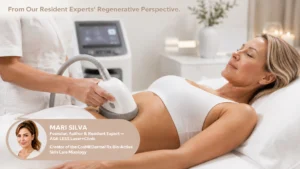
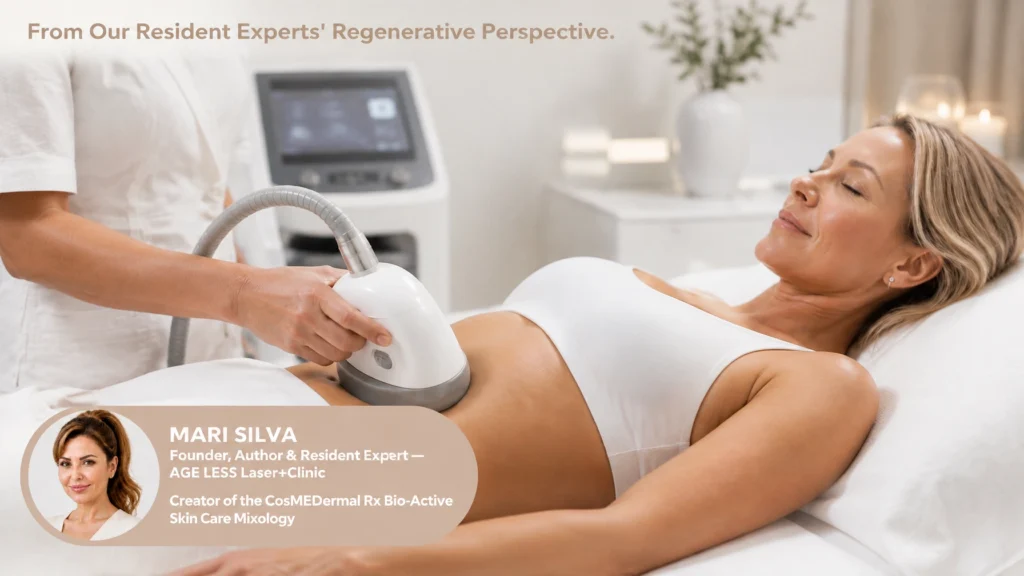
When excessive adipose tissue is present, targeted inch loss and fat reduction treatments may need to be done first to reduce the underlying volume and tighten the skin. At AGE LESS, that phase may include Quantum Reduce with Cryolipolysis and/or Lipo Laser, depending on the area and the assessment findings.
Once the best proportions are reached, the cellulite is then reassessed. Only then is the most targeted protocol designed to address the specific stage and type of cellulite present.
This phased order is deliberate. Treating cellulite texture before reducing excess volume would mean working on the wrong problem in the wrong order.
The broader AGE LESS cellulite technology array
AGE LESS offers an extensive array of European QUANTUM technologies, and the multiple technologies used across volume reduction, contour refinement and cellulite care are outlined below. These may include Quantum Reduce, Cryolipolysis, Lipo Laser and the cellulite-focused modalities selected according to tissue presentation.
In addition to radiofrequency, AGE LESS may draw from a wider European-style technology menu to build a more precise cellulite plan:
- ElectroMesotherapy with sterile, homeopathic cocktail infusions: Selected when the goal is to support circulation, tissue quality and localized skin and surface improvement through targeted topical infusion without traditional injections. It may be considered in softer or mixed-pattern cellulite where skin quality and tissue vitality need support.
- SlimToning with Faradic and Microcurrents: Used to encourage muscle re-education, improve tone and support the look of firmer underlying tissue. It may be selected when reduced tone contributes to softer or flaccid cellulite.
- MicroCavitation with Ultrasounds: Used to support contour refinement in areas where localized fat volume contributes to unevenness. It may be considered when cellulite presents alongside fuller pockets of stubborn body fat.
- Electrolipolysis: Used to support localized fat metabolism and contour work in selected areas as part of a broader non-surgical body strategy. It may be considered in plans where contour irregularity and fat volume are relevant factors.
- Targeted FIR wraps: Used to provide gentle, targeted heat support that may assist circulation, comfort and fluid movement. They may be selected when tissue congestion, heaviness or slower fluid dynamics are part of the picture.
- Synchronized Lymphatic Drainage: Used to support fluid movement, tissue congestion and circulation, and often selected alongside structural modalities when fluid retention is contributing to the overall presentation, particularly in edematous patterns.
Many clients require a combination of these therapies rather than one single modality to achieve the most complete result. That does not mean a harsher experience. These therapies are generally selected to work together in a comfortable, painless and often deeply relaxing way.
No single modality suits every client. Some technologies are better suited to softer cellulite with laxity. Others are more relevant when localized fat, fluid retention or fibrous density are stronger drivers. The value lies in selecting the right combination, in the right order, for the right tissue presentation.
Radiofrequency for skin firmness and collagen support
Radiofrequency uses controlled thermal energy to warm selected tissue layers. Depending on the technology and treatment plan, this may support collagen remodeling, improve the appearance of skin laxity and encourage a firmer-looking surface.
Radiofrequency does not directly correct every structural cause of cellulite. Its value increases when it forms part of a broader plan that also considers localized fat, fluid movement and tissue quality.
Over time, collagen induction may help improve the appearance of uneven or crepey skin. Results develop progressively because the body requires time to remodel collagen and connective tissue.
For further information, see Radiofrequency Skin Tightening: Supporting Firmer-Looking Skin Without Surgery.
Non-surgical body contouring for localized fat and shape
Non-surgical body contouring is designed to refine selected areas of localized fat or support overall body definition. It is not a weight-loss treatment, and it should not be presented as a definitive cure for cellulite.
When localized fat contributes to the appearance of unevenness, contouring may form one part of a customized plan. The clinician must still assess whether the dominant concern involves fat volume, skin laxity, fibrous dimpling or a combination of factors.
This distinction matters. Improving body contour and improving cellulite are related goals, but they are not identical goals.
AGE LESS also explains the difference between contour refinement and weight loss in How to Get Rid of Body Fat: Why Body Contouring Isn’t About Weight Loss.
Lymphatic drainage as supportive care
Lymphatic drainage uses gentle, directed techniques to support the movement of excess fluid through the lymphatic system. It may help reduce temporary puffiness and create a lighter, smoother appearance in some clients.
However, lymphatic drainage alone does not address the fibrous bands associated with cellulite. Its role is supportive rather than definitive.
It may be considered when fluid retention, post-treatment comfort or tissue congestion forms part of the overall concern. Hydration, regular movement and appropriate recovery habits can also support normal fluid movement.
Learn more about the role of lymphatic drainage and when professional support may be appropriate.
Collagen induction for skin texture and resilience
Collagen induction aims to stimulate the skin’s natural repair response. When suitable for the individual and treatment area, it may support improvements in skin texture, firmness and resilience.
Cellulite often appears more visible when the overlying skin becomes thinner or less elastic. Improving skin quality can therefore soften the overall appearance, although collagen induction does not automatically release every fibrous tether beneath the skin.
A considered protocol may combine collagen induction with radiofrequency or other European regenerative technologies when the clinical assessment supports that strategy.
What does cellulite treatment feel like?
Client comfort remains part of clinical efficacy. A treatment that cannot be tolerated comfortably cannot be delivered consistently or appropriately.
Depending on the modality, clients may experience:
- Gentle warmth
- Mild pressure or suction
- A rhythmic massage-like sensation
- Temporary sensitivity or redness
- A feeling of tissue movement during lymphatic support
- Mild post-treatment tenderness in selected protocols
Treatment settings can be adjusted according to the area, tissue response and individual sensitivity. A calm boutique setting also gives clients time to ask questions, understand the process and communicate throughout the session.
High-volume clinics often rely on fixed protocols and rapid turnover. AGE LESS takes a different approach, combining European-style clinical guidance with a quieter, more personalized experience.
Think in terms of an investment, not a quick purchase
Some clients notice an early improvement in tissue feel, fluid movement or contour after the first visit. More meaningful and lasting changes generally require a customized series because collagen remodeling, tissue adaptation and contour refinement develop gradually.
The appropriate number and spacing of sessions depend on:
- The degree and type of cellulite
- Skin quality and elasticity
- Localized fat distribution
- The selected technology or combination
- Recovery capacity and lifestyle factors
- The client’s desired degree of improvement
Maintenance remains important because the aging process continues. Hormonal changes, weight fluctuations, sun exposure, reduced activity and collagen decline can all influence the appearance of cellulite over time.
A personalized mini-maintenance package may help preserve the initial investment and offset ongoing changes. The goal is not to chase an unrealistic promise of permanent eradication. The goal is to maintain a healthier-looking, smoother and more supported appearance over time.
Frequently asked questions about cellulite reduction treatments
Does cellulite reduction really work?
Cellulite reduction treatments can improve the appearance of cellulite, but no non-surgical treatment can guarantee complete or permanent removal. The most appropriate results usually come from matching the treatment plan to the contributing factors, then completing a suitable series with maintenance.
How many cellulite reduction treatments will I need?
There is no universal number. Some clients require a focused series, while others benefit from a longer layered plan addressing skin laxity, localized fat, collagen support and fluid movement. The recommendation depends on the assessment, treatment area and desired outcome.
Is non-surgical body contouring painful?
Most non-surgical body contouring treatments are designed to be comfortable and non-invasive. Sensations can include warmth, pressure, suction or rhythmic movement. Comfort is monitored throughout the session, and settings can be adjusted when clinically appropriate.
Why does cellulite treatment need to be personalized?
Because cellulite is not one uniform condition. It presents in different types and different stages, and each pattern responds best to a different clinical emphasis. A softer, lax presentation may require more tissue support and collagen stimulation, while a compact fibrous presentation may call for a different layered strategy, and an edematous presentation may need stronger fluid and circulation support. Personalization helps ensure the plan fits the tissue actually being treated.
Can lymphatic drainage get rid of cellulite?
No. Lymphatic drainage may temporarily reduce fluid retention and support a smoother appearance, but it does not remove the fibrous connective bands associated with cellulite. It is best considered a supportive component of a broader plan.
Will cellulite come back after treatment?
Cellulite can become visible again because aging, hormonal changes, weight fluctuation, skin laxity and tissue changes continue. A customized maintenance plan, stable body composition, regular movement and appropriate home care can help support the improvement achieved.
Is cellulite reduction suitable for everyone?
Not necessarily. A consultation should review medical history, medications, circulation, skin condition, previous procedures and personal goals. If cellulite is associated with unexplained swelling, pain or a sudden change, medical evaluation may be recommended before Appearance Enhancement treatment.
A more informed next step
Cellulite does not require shame or a rushed decision. It requires accurate assessment, realistic expectations and a strategy that respects how the body changes over time.
Ask which tissue layers are contributing to the appearance of cellulite. Ask whether the plan addresses skin quality, localized fat, fluid movement and collagen support. Ask how the result will be maintained after the initial series.
That is the difference between choosing a quick fix and making a considered investment in non-surgical body contouring.
Serving Esquimalt & the greater Victoria area for over 20 years.